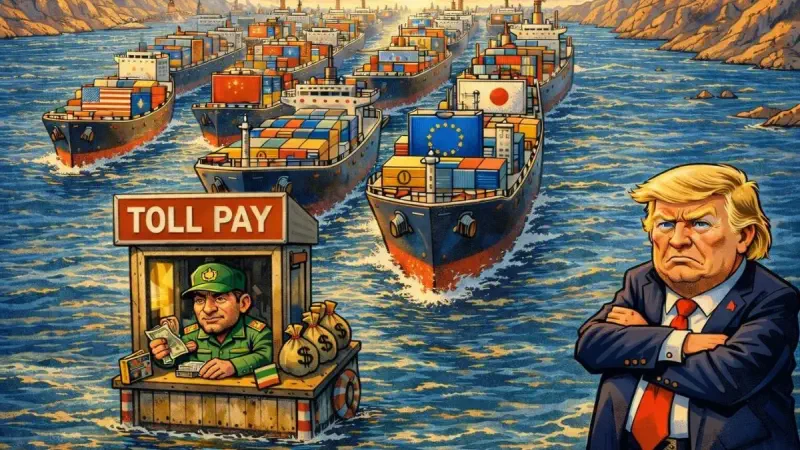
When wars break out, governments deploy missiles, sanctions, intelligence networks, and diplomacy. But in the digital age, another weapon appears almost immediately: the meme.
During the Israel–Iran crisis, social media platforms were flooded with jokes, edited videos, sarcastic graphics, AI-generated clips, and viral one-liners. Some mocked military leaders. Others ridiculed politicians, exaggerated battlefield claims, or turned serious geopolitical developments into entertainment. To many users, this content appears harmless—just internet humour moving at internet speed. But memes are rarely just jokes. They shape emotion, attention, memory, and, increasingly, public opinion.
The central reality of modern conflict is simple: people no longer experience war only through news reports. They experience it through feeds. Memes are powerful because they compress complex events into something instantly understandable. A 2,000-word policy article explaining escalation dynamics may be ignored; a meme communicating the same emotional message can spread widely within minutes. In political contexts, memes function as persuasive narratives disguised as entertainment.
This matters because most people do not study military strategy or regional history before forming opinions. They rely on cognitive shortcuts. Psychologists refer to these as heuristics—mental cues used when information is complex or overwhelming. Memes are almost perfectly designed to exploit these shortcuts. They are fast, emotional, visual, and easy to remember.
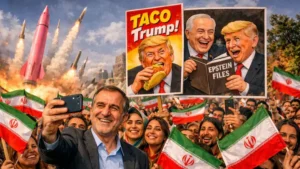 During the Israel–Iran crisis, many memes framed the conflict less as a strategic confrontation and more as a contest of humiliation. One side was depicted as weak, the other reckless. Leaders were portrayed as cartoon villains, confused elders, gamblers, or puppets. Some content celebrated missile strikes; some mocked civilian panic; others reduced years of geopolitical tension to a sports-style rivalry.
This is where humour acquires political significance. Humour lowers resistance. Audiences are often sceptical of messaging that feels overtly persuasive, but jokes tend to bypass that instinct. Satire appears lighter, more organic, and easier to engage with—which explains its high shareability. A formal speech may be ignored; a meme conveying the same argument is readily amplified.
Social media platforms intensify this effect. Their algorithms privilege content that maximises engagement, not necessarily accuracy or nuance. As a result, anger, ridicule, sarcasm, and group-driven reactions travel faster than careful analysis. A serious explanation of deterrence strategy is unlikely to go viral, while a meme comparing missile strikes to a video game can circulate globally in minutes. Coverage of the conflict has repeatedly shown how memes convert complex geopolitical events into “snackable” content, often creating a misleading sense of understanding.
This illusion is consequential. When users repeatedly consume meme-based narratives, they begin to “know” a conflict through emotional impressions rather than verified information. One side appears consistently dominant, the other persistently incompetent. Complex motivations disappear. Civilian suffering risks becoming background noise.
This dynamic also shapes how political leaders are perceived. When a president or prime minister is repeatedly reduced to a punchline during a crisis, public perception can gradually shift. Repetition matters. Persistent portrayals of a leader as weak, confused, reckless, or externally controlled can embed themselves even among audiences not closely tracking events.
That is where meme warfare acquires practical significance. Memes alone may not dramatically alter approval ratings, but they amplify existing sentiments. When publics are already uneasy—about economic strain, casualties, foreign entanglements, or escalation risks—memes translate diffuse anxieties into sharp, shareable narratives. They give form and language to otherwise inchoate dissatisfaction.
The Israel–Iran crisis also highlights the expanding role of synthetic media. Since the onset of conflict, there has been a surge of misleading visuals, unverified claims, AI-generated propaganda, and competing narratives pushed by different actors. In such an environment, the boundary between satire and disinformation becomes increasingly blurred. What begins as humour can easily merge with manipulation.
For strategists, policymakers, and security practitioners, this domain cannot be dismissed as trivial. Morale, legitimacy, and narrative dominance have always been central to warfare. Earlier eras relied on propaganda posters, radio broadcasts, and political cartoons. Today, these functions are performed by memes—faster, cheaper, decentralised, and globally scalable.
For the public, the challenge is media literacy. Before sharing a meme about war, it is worth asking: Who created this? What emotion is it trying to trigger? What context is missing? Is it satire, persuasion, or manipulation? Does it trivialise suffering or distort reality?
None of this suggests that memes are inherently harmful. They can humanise conflict, expose hypocrisy, provide emotional relief, and serve as tools of dissent. Humour has always had a political function. But in a networked information environment, humour is no longer neutral—it is an instrument.
The Israel–Iran crisis demonstrates that modern conflicts are fought simultaneously in physical, cyber, and cognitive domains. Missiles shape territory; narratives shape perception. And in democratic societies, perception often shapes policy.
People laugh. They share. And, often without realizing it, they begin to believe.

Paramjeet Singh is a seasoned professional with over 16 years of experience in the Information Technology domain, complemented by a deep academic and research engagement in Defence and Strategic Studies. A Gold Medallist from Panjab University, Chandigarh, he holds a Master’s degree in Defence & Strategic Studies and is currently pursuing a Ph.D. with a focus on Cognitive Warfare. His research spans critical areas such as cyber security, national security strategy, and international relations.